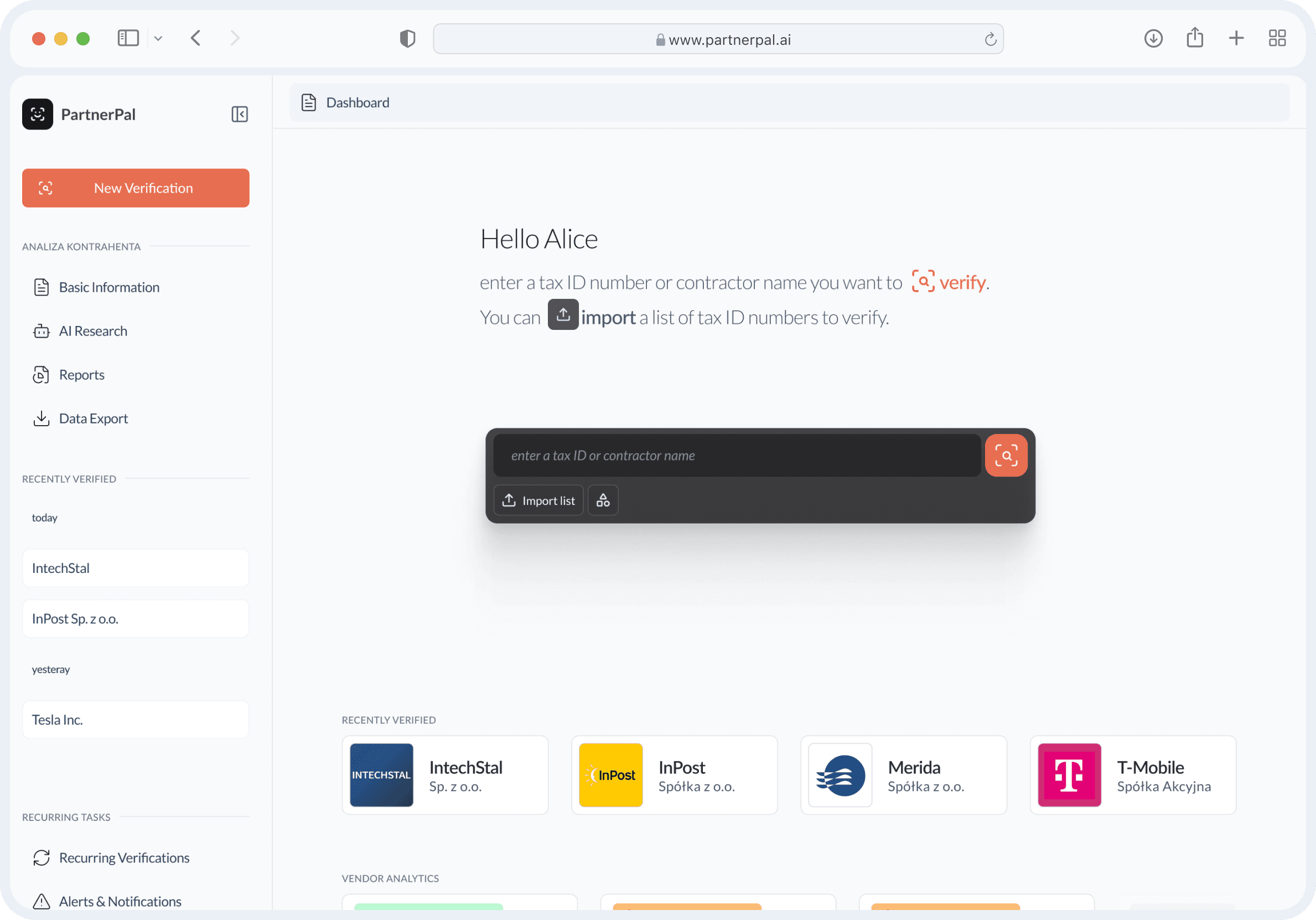
Scope of verification
There is no single mandatory list of registers. The scope depends on your specific risks: deferred payment, sanction compliance, or continuity of supply — and if you are an obliged entity, it is determined by the risk assessment and financial security measures under the AML Act. Below are the four layers where you typically begin.
Auditable PDF reports
Each report links to its sources, so findings can be verified and used in a documented verification process.
AI-powered data interpretation
AI supports analysts in connecting signals from multiple sources, interpreting the data, and producing recommendations that speed up decision-making.
Recurring portfolio verification
Schedule automated counterparty checks and respond as soon as new risk signals appear.
Public sources and web context
Combine register data with information you won't find in any single database: media coverage, reviews, events, and market context.
From tax ID to report and monitoring
Verify a single company or your entire portfolio. PartnerPal gathers the data, organizes the findings, and highlights areas that need your attention.
1. Add a company or a list of entities
Search for a company or import a file with tax IDs for bulk verification.
2. Run a multi-source analysis
PartnerPal combines data from official registers, sanctions lists, and the web, using AI to analyze publicly available information.
3. Get an auditable report
Download a PDF report with a summary, flagged issues, and links to sources.
4. Turn on monitoring
Set up recurring verifications and get alerts whenever significant changes occur.
With PartnerPal, you simply import a file with tax identification numbers (NIP) and run a single request — for every company, you receive the same organized risk profile with links to sources, and you can immediately set up monitoring and alerts for the entire list. Instead of days of manual checking: a single import and clear signals that warrant a response.
Client story

PartnerPal cut our vendor research time from hours to just dozen or so minutes. Instead of manually checking disparate sources, we get a structured risk overview and actionable insights.

Mateusz Karaśkiewicz
Founder & CEO, Contigate
Result: 78% less time spent on research
1 report instead of manually reviewing 8 sources
Legal context
July 10, 2027
The AMLR regulation enters into force across the EU.
July 10, 2027
The transposition deadline for Directive 2024/1640, which covers, among other things, the rules on access to beneficial ownership registers.
Previously
National changes. In Poland, work is underway on an amendment to the AML Act, which includes a new GIIF ICT system and the restructuring of access rules to the CRBR.
PartnerPal organizes publicly available information and highlights what to look out for — but it does not make business decisions or replace your own risk assessment. The report documents the scope and date of the check — the conclusions and the decision to cooperate remain yours. The exact set of sources depends on the service variant.
FAQ
Frequently Asked Questions
If you didn't find the answer to your question,
contact us or leave your details and we will call you back.
How to verify a business partner by NIP number?
Enter the NIP (tax identification number) in PartnerPal or import a file containing a list of numbers. The system queries registers and lists, analyzes publicly available information, and delivers the result as a report with links to the sources.
How long does the verification of one company take?
It depends on the complexity and scope of the report. For basic data, it takes a few seconds; for a comprehensive AI analysis of a large company, it takes a few minutes.
Can the report be saved and archived?
Yes. You can save the report as a PDF, receive it via email, or transfer it to another system using the API.
Does the verification include foreign contractors?
For European Union entities, VIES verification is available, and sanction screening covers both European and international lists. The scope of registry data outside Poland depends on the service variant — write to us, and we will check the specific country.
How does this differ from a free search in the National Court Register (KRS)?
Free search engines answer a single question in one register. Here you get multiple sources compiled together, highlighted points of attention, an archived report, and the option to enable monitoring.
Can the report be customized to meet AML, compliance, and procurement needs?
Yes. The scope of the report and alerts can be customized to fit the specific processes and requirements of your organization — from AML and compliance to supplier assessment in procurement departments.
Do the new AML regulations change the scope of counterparty verification?
Regulation (EU) 2024/1624, applicable from 10 July 2027, requires not only customer identification, but also establishing the ownership and control structure, as well as sanction screening of the customer and their beneficial owners. The scope of these obligations depends on whether your company is an obliged entity — this is worth determining with a legal advisor.
Will my company be an obliged entity?
The regulation expands the catalog beyond the financial sector — it includes, among others, trade in high-value goods, precious metals and stones, cultural goods, real estate brokerage, and crypto-asset service providers. Qualification depends on your business profile and requires a legal assessment on your part.